Top architectural landmarks in america architecture in the United States is rarely a singular expression of style; rather, it is a sedimentary record of ambition, tension, and technological transition. To survey the continent’s most significant structures is to trace a path from the colonial adaptation of European Neoclassicism to the vertical audacity of the steel-framed skyscraper. These landmarks are not merely static monuments but are functioning nodes within a complex cultural and economic network. They represent the moment where engineering necessity meets the aspirational zeitgeist of an era, often at a scale that challenges existing urban paradigms.
The definition of a landmark has evolved from the strictly historical to the structurally innovative. While early American architecture focused on the symbolic weight of stone and symmetry to project democratic stability, the 20th century introduced a radical departure through the Chicago School and the subsequent International Style. This shift replaced the ornamental with the functional, the heavy with the transparent. Understanding these transitions requires a nuanced look at the materials—limestone, steel, glass, and reinforced concrete—that allowed the American skyline to detach itself from the horizontal constraints of the Old World.
In the contemporary landscape, the significance of a landmark is increasingly measured by its “Structural Resilience” and its relationship to the public realm. A building’s authority is no longer granted solely by its height or the pedigree of its architect; it is earned through its longevity and its ability to adapt to shifting social and environmental demands. This editorial serves as a rigorous interrogation of the American built environment, moving beyond the facade to examine the systemic innovations and philosophical shifts that define the country’s most enduring structures.
Understanding “top architectural landmarks in america”

The pursuit of the top architectural landmarks in america involves navigating a landscape of shifting definitions. A landmark is often misunderstood as simply a “famous” building. However, from an editorial and engineering perspective, a landmark is a structure that introduces a “Disruptive Innovation”—a change in how we manage load, light, or human density. For instance, the Empire State Building is a landmark not merely for its Art Deco crown, but for the logistical masterpiece of its rapid-fire construction, which served as a prototype for modern project management.
The risk of oversimplification in this field is high, particularly when focusing on the “Iconic Facade.” A multi-perspective view reveals that the true value of these landmarks often lies in their “Sub-Structural” reality. The Chrysler Building’s beauty is undeniable, but its historical weight is anchored in its use of Enduro KA-2 stainless steel—a material choice that challenged the prevailing atmospheric corrosion risks of early 20th-century New York. To evaluate a landmark, one must look at the “Integrated Performance”: how the envelope, the core, and the site interact over decades.
Furthermore, we must address the “Geographic Bias” that often favors the urban density of the Northeast and the Midwest. The architectural identity of America is equally rooted in the sprawling, horizontal innovations of the West—such as the Gamble House’s celebration of the Arts and Crafts movement or the mid-century modernism of the Salk Institute. True mastery of this topic requires acknowledging that a landmark can be a 1,400-foot tower or a single-story concrete laboratory, provided it redefines the relationship between the inhabitant and the environment.
Contextual Background: The Evolution of the American Skyline
Top architectural landmarks in america the American architectural narrative is divided into four distinct tectonic shifts. The first was the Classical/Civic Era, dominated by the Federal and Greek Revival styles, where architecture was used as a tool for nation-building. Structures like the U.S. Capitol served as an “Architectural Anchor,” using the language of Rome and Greece to bestow a sense of antiquity on a young republic.
The second shift was the Industrial/Vertical Revolution. Following the Great Chicago Fire of 1871, the necessity for fireproof, dense construction led to the birth of the steel skeleton. This era proved that the exterior wall no longer had to support the weight of the building, allowing for the “Curtain Wall” and the birth of the modern skyscraper. The third phase, High Modernism, saw the stripping away of all ornament in favor of the “Universal Space,” characterized by the work of Mies van der Rohe.
Conceptual Frameworks and Mental Models Top Architectural Landmarks In America
The “Load-Path” Mental Model
This framework suggests that a landmark’s significance can be measured by how it innovates the journey of weight from the roof to the soil. The Brooklyn Bridge, for example, is a landmark because it mastered the “Tension-Compression” hybrid, using massive stone towers to manage compression while steel cables handled the tension of the span.
The “Aesthetic-Function” Trade-off
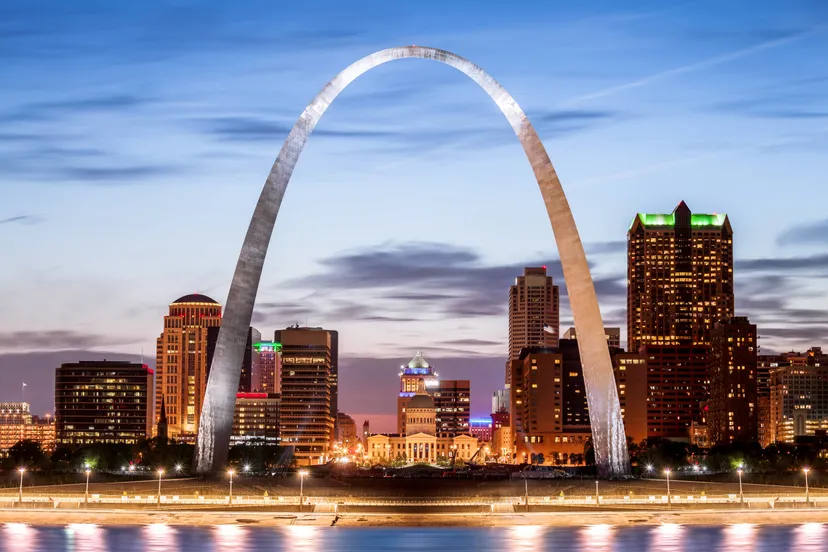
A landmark often exists at the extreme edge of this spectrum. A structure that is 100% functional is a utility; a structure that is 100% aesthetic is a sculpture. A landmark is the “Synthesis,” where the structural necessity dictates a new aesthetic language. The Gateway Arch is the pinnacle of this, where the mathematical catenary curve provides both the structure and the form.
The “Adaptive Reuse” Lifecycle
This model evaluates a landmark’s ability to survive the death of its original purpose. The most resilient landmarks—like the Ferry Building in San Francisco—successfully navigate the transition from an industrial hub to a commercial center without losing their “Structural DNA.”
Key Categories of Landmark Typology
Realistic Decision Logic Top Architectural Landmarks In America
When identifying the top architectural landmarks in america, the selection logic should prioritize “First-of-Kind” status. A building that simply follows a trend is a “Style Example”; a building that starts a trend is a “Landmark.”
Detailed Real-World Scenarios Top Architectural Landmarks In America
The “Floating” Foundation of Chicago
-
The Problem: The soil in Chicago is a “soft clay” that could not support the weight of heavy masonry buildings.
-
The Innovation: The Montauk Building and subsequent landmarks utilized the “Floating Grillage”—layers of steel rails embedded in concrete to distribute weight over a wider area.
-
Result: This allowed the city to grow vertically despite the geological constraints.
The “Exoskeleton” of the Sears (Willis) Tower
-
The Problem: As buildings exceeded 100 stories, “Wind Sway” became a greater risk than gravity.
-
The Innovation: The “Bundled Tube” system—nine interconnected square tubes that act as a single, rigid exoskeleton.
-
Logic: By moving the structural support to the exterior, the interior was freed for flexible office space.
Planning, Resource Dynamics, and Material Economics
The construction of a landmark is an exercise in “Resource Concentration.”
Tools, Strategies, and Preservation Systems Top Architectural Landmarks In America
-
Laser Scanning/Lidar: Creating 3D digital twins of landmarks like the Statue of Liberty to monitor structural “Creep” or erosion.
-
Cathodic Protection: Used in concrete and steel landmarks near coastal environments to prevent saltwater-induced corrosion.
-
Tuned Mass Dampers: Large weights at the top of skyscrapers (like the Comcast Technology Center) that counteract wind oscillation.
-
Section 106 Review: A federal regulatory tool that ensures any project using federal funds does not adversely affect a landmark’s historical integrity.
Risk Landscape and Failure Modes of the Built Environment
-
The “Material Fatigue” Risk: High-rise glass from the 1970s often faces seal failure, leading to massive energy loss and interior moisture damage.
-
The “Seismic Vulnerability” Gap: Many early landmarks were built before modern lateral-load requirements. Retrofitting these without destroying the “Historic Fabric” is the primary challenge of West Coast architecture.
-
The “Obsolescence” Trap: A landmark can become a “Stranded Asset” if its floorplates are too small for modern office requirements or its mechanical systems are too expensive to upgrade.
Governance, Maintenance, and Long-Term Adaptation
The “License to Stand” for a landmark is a matter of governance.
The Maintenance Hierarchy:
-
Exterior Envelope (Annual): Monitoring for “Spalling” masonry or rusted steel connections.
-
Vertical Transportation (Daily): Ensuring the elevator systems—the “Circulatory System” of the tower—are operational.
Measurement, Tracking, and Evaluation of Significance Top Architectural Landmarks In America
How do we quantify a landmark’s “Top” status?
-
Leading Indicators: Architectural citations in academic journals; “Pedestrian Draw” (foot traffic/tourism).
-
Lagging Indicators: Property valuation premium; inclusion on the National Register of Historic Places.
-
Documentation Examples:
-
HABS/HAER Records: Detailed drawings and photographs of historic American buildings.
-
Structural Health Reports: Periodic audits of a building’s load-bearing capacity.
-
Common Misconceptions and Oversimplifications
-
Myth: “Old buildings are always more durable.” Correction: Many 19th-century buildings have “Poor Fire Resistance” and significant structural vulnerabilities compared to modern reinforced concrete.
-
Myth: “Landmarks must be beautiful.”
-
Myth: “Height is the only metric for a skyscraper.” Correction: The “Aspect Ratio” (the ratio of height to width) is a more significant engineering metric for difficulty and innovation.
Conclusion Top Architectural Landmarks In America
The study of the top architectural landmarks in america is ultimately a study of human persistence. From the granite foundations of the Brooklyn Bridge to the parametric curves of contemporary concert halls, these structures represent our attempts to negotiate with the forces of nature and the constraints of our own era. A landmark is not just a destination; it is a “Chronicle of Capability.” By understanding the engineering logic and the cultural intent behind these structures, we move from being passive observers of our cities to active participants in the preservation of our built legacy.
Leave a Reply